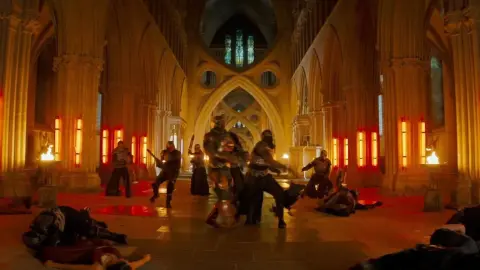
A short drive from Wells, the production descended underground. Wookey Hole Caves — a dramatic limestone cave system known for its winding tunnels and naturally sculpted chambers — provided ancient, subterranean Eternian environments.
Even more striking was the choice of Beer Quarry Caves near Seaton, Devon. Beer Quarry Caves has a history stretching back to Roman times. Its stone was used in the construction of Exeter Cathedral, St Paul's Cathedral, Westminster Abbey, the Tower of London, Hampton Court, and Windsor Castle. The caves became Skeletor's dark underground territory — their winding tunnels and dramatic rock formations providing a mysterious and intimidating atmosphere. The vaulted ceilings and stone pillars, described by visitors as resembling an underground cathedral, gave the production the scale it needed for subterranean sequences.
The Devon Film Office described the shoot as "a wonderful South West showcase of locations, crew, local communities, and team collaboration." The production spent around two weeks in the county, requiring local road closures and extensive coordination with Somerset and Devon authorities.
Before He-Man arrives on Eternia, Prince Adam lives a very ordinary life on Earth. London's Canary Wharf — the glass-and-steel financial district on the Thames — was chosen for its sleek, futuristic backdrop, with scenes filmed at Cabot Square and inside Canary Wharf tube station, contrasting sharply with the mythical world Adam will return to.
The production's main studio base was Sky Studios Elstree, with additional work at Bray Film Studios. Major interior sets — Castle Grayskull, the royal city of Eternos, Skeletor's strongholds — were built on the soundstages in Borehamwood, Hertfordshire, one of Britain's most established filmmaking hubs and home over the decades to Star Wars and the original Harry Potter films.
The producten used Italy and Iceland for the wilderness. The Dolomites in northern Italy — a UNESCO World Heritage site with jagged peaks and near-alien rock formations — provided sweeping exterior shots that establish the vast, untamed regions of Eternia.
Iceland's volcanic terrain, black sand plains, and desolate remote landscapes were used to represent the wild outer regions of the planet. Together, the two countries gave the film the sense of an entire world.