
Little House on the Prairie is back - and this time, it's the real prairie
Little House on the Prairie
For fifty years, Walnut Grove existed in Simi Valley, California. Michael Landon built it there, blew it up when the show ended, and wildfires finished the rest. Netflix's new Little House on the Prairie starts over — not in Southern California, but in Winnipeg, Manitoba, on genuine prairie land where the horizon goes on forever and October actually feels like October.
For nine seasons, from 1974 to 1983, Michael Landon's Little House on the Prairie convinced millions of viewers they were watching the windswept plains of Minnesota. They were not. Every exterior scene — the town of Walnut Grove, the Ingalls family farm, the church, the mercantile — was filmed at Big Sky Movie Ranch on Bennett Road in Simi Valley, California, about forty miles northwest of Los Angeles.
When the series ended, Michael Landon — furious at NBC for failing to personally inform him of the cancellation — had the sets of Walnut Grove blown up on screen. Whatever remained burned to the ground in the California wildfires of 2003.
Netflix's new adaptation, premiering July 9, made a fundamentally different location decision. Unlike the original series filmed at Big Sky Ranch in Simi Valley, this reboot was shot in Winnipeg, Manitoba.
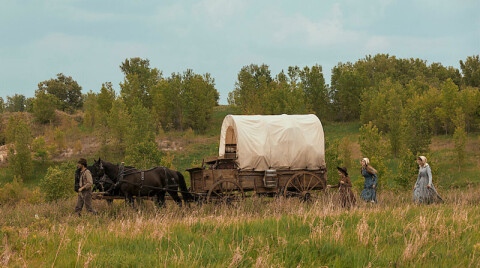
The heart of the production is a small rural community about 45 kilometres east of Winnipeg. Cooks Creek served as the primary location for the show's expansive prairie and homestead sets — the Ingalls family cabin, the surrounding fields, the open land that stretches to the horizon in every direction. It is exactly the kind of place the original production team spent years trying to fake in Southern California. Here, it simply exists.
Rather than relying on soundstages, the production built large outdoor sets across the Winnipeg area and surrounding rural landscapes, filming extensively in real environments. Natural lighting and weather conditions were allowed to shape the look and tone of the series directly.
Principal photography ran from June 10 through October 2025, under the working title Independence. The production focused deliberately on capturing seasonal change — summer heat fading into autumn colour, the first cold arriving — using the natural rhythm of the Manitoba year to shape the look and tone of the series. Starting in June and shooting into October meant the crew could document an entire prairie season.
Continue reading below the ad



For the show's outdoor historical sequences and winter-weather shoots, the production turned to Fort Gibraltar in Winnipeg's St. Boniface neighbourhood. Originally built in 1810 at the confluence of the Red and Assiniboine rivers by the North West Company, Fort Gibraltar was a key fur trade post in early 19th-century Manitoba — its blacksmith shop, trading post, and winterer's cabin still reconstructed and standing today.
The reconstructed fort is best known today for hosting the Festival du Voyageur every February — the largest winter festival in Western Canada — and operates as a living history museum in summer, with costumed interpreters depicting life in 1815. For a production set in 1869, it required minimal dressing.
Little House on the Prairie premiers on July 9 on Netflix and they have already renewed the series for a second season, which will also be filmed in Winnipeg.
SOURCE
Hollywood North Buzz // 4Filming // What's on Netflix // Little House on the Prairie official site // Collider // SlashFilm
CREDITS
© Netflix, CBS Studios, Anonymous Content, Friendly Family Productions, Joy Coalition
with our self-guided film walking tours
Discover how films are made, why locations matter and other behind-the-scenes stories.


download now, it's free!